How to Pass a Prop Firm Challenge: A Rule-First Plan (2026)
A practical plan to pass a prop firm challenge: read the exact rules, size risk from the loss limits, set your own daily stop and avoid the rule traps.
To pass a prop firm challenge, plan around the loss limits first and the profit target second. The target tells you where to go, but the daily and maximum loss limits decide whether your account survives long enough to get there. In practice that means four things: know your exact rules, size every trade from the loss limit, stop for the day well before the firm stops you, and avoid the rules that end accounts on a technicality. This guide turns that into a 7-step plan with numbers you can reuse.
Examples use the official rules of FTMO and FundedNext, checked on 26 November 2026. This is general education, not financial advice.
Key takeaways
- Risk 0.25–0.5% per trade on a 2-step: that leaves 20–40 losing trades before a 10% maximum loss.
- Set a personal daily stop at about half the firm's daily limit.
- Neither FTMO nor FundedNext sets a time limit, so there is no reason to rush the target.
- Read the small rules – consistency, news and EA rules – before your first trade, not after a breach.
Step 1: Know the exact rules of your account
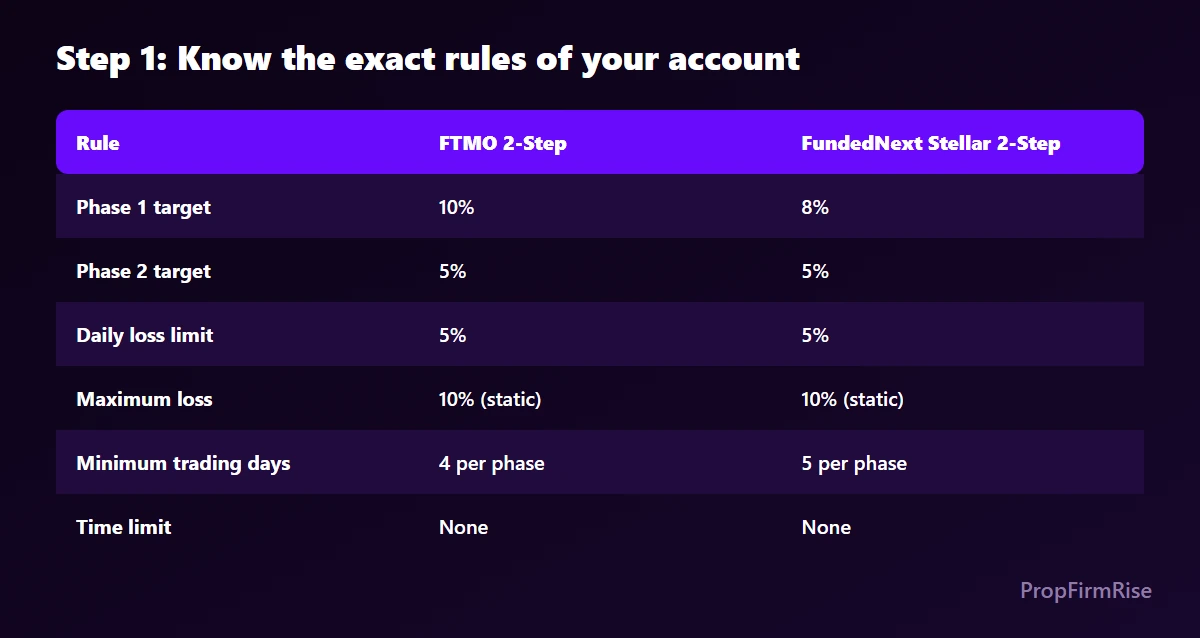
Every challenge has a profit target and two loss limits, and the numbers differ by firm and by model. If you are new to the models, start with what is a prop firm challenge. Here are two popular 2-step accounts side by side (FTMO, FundedNext):
| Rule | FTMO 2-Step | FundedNext Stellar 2-Step |
|---|---|---|
| Phase 1 target | 10% | 8% |
| Phase 2 target | 5% | 5% |
| Daily loss limit | 5% | 5% |
| Maximum loss | 10% (static) | 10% (static) |
| Minimum trading days | 4 per phase | 5 per phase |
| Time limit | None | None |
Then read how each limit is measured. At FTMO, the daily limit is recalculated at 00:00 CE(S)T from your balance at that moment. On a 1-Step account with a 3% daily limit, a $100,000 account that closed the day at $102,000 may not drop below $99,000 the next day (FTMO). Open trades count: the limit applies to equity, not just closed trades. Our guide to daily loss vs max loss explains both limits in detail.
Step 2: Size every trade from the loss limit
The most useful number in a challenge is how many losing trades in a row you can survive. Divide the limit by your risk per trade:
| Risk per trade | On a $100,000 account | Losses to hit a 5% daily limit | Losses to hit a 10% maximum loss |
|---|---|---|---|
| 0.25% | $250 | 20 | 40 |
| 0.5% | $500 | 10 | 20 |
| 1% | $1,000 | 5 | 10 |
| 2% | $2,000 | 2.5 | 5 |
This is our own calculation from the 5% and 10% limits above. At 2% per trade, three losers in one day break a 5% daily limit, and five in a row end the challenge. At 0.5%, the same streak costs 1.5% and you are still trading.
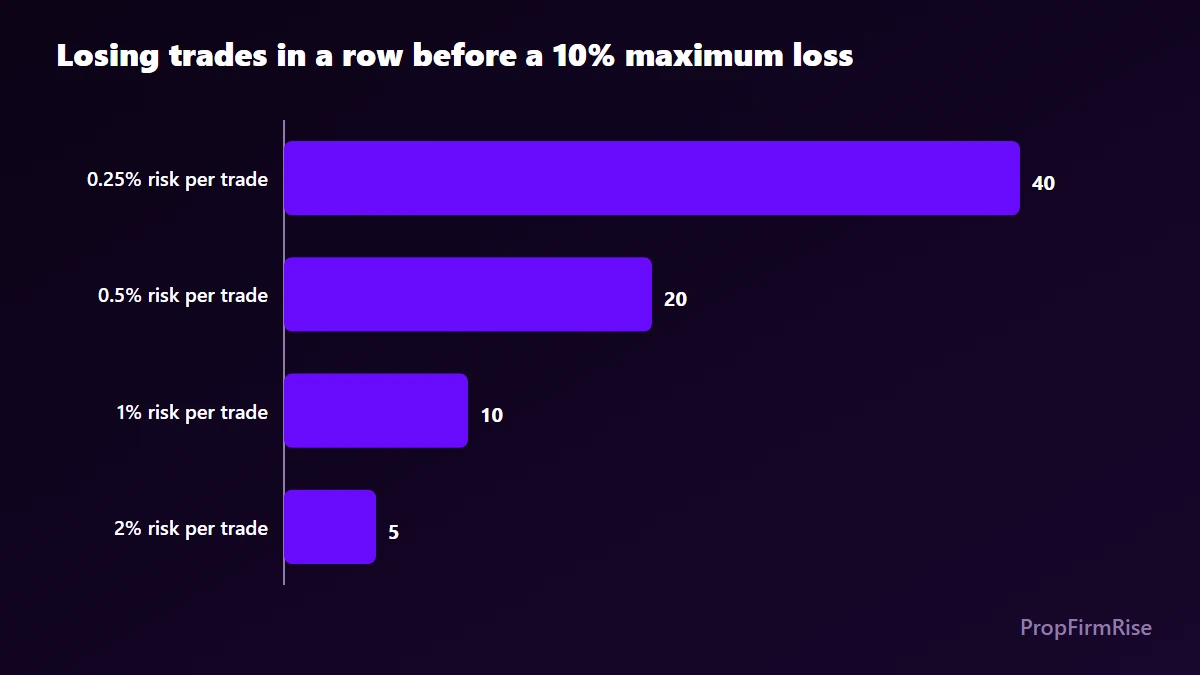
The trade-off is speed. A 10% target is 20R at 0.5% risk per trade, 10R at 1% and 5R at 2% (R is the amount you risk on one trade). FundedNext's 8% Phase 1 target is 16R at 0.5%. With no time limit at either firm, the slower path costs you time, not the account.
Step 3: Set your own daily stop below the firm's
The firm's daily limit is a cliff edge, not a target. Set a personal stop at roughly half of it and walk away when you hit it:
- 5% daily limit (most 2-step accounts): stop for the day at about 2–2.5%.
- 3% daily limit (FTMO 1-Step, FundedNext Stellar 1-Step): stop at about 1.5%.
Also stop after 3 losing trades in a row, whatever the amount. Trying to win back an early loss on the same day is one of the quickest ways to break a daily limit. A hard personal stop takes that decision away from you while you are tilted.
Step 4: Treat the target as a long-term goal
Neither FTMO nor FundedNext puts a time limit on its challenges. You only have to meet the minimum trading days: 4 per phase at FTMO and 5 per phase at FundedNext.
That changes the right strategy. Trade your normal setups at your normal size, skip days with no setup, and let the target arrive. Doubling your size near the end of a phase to "finish it" turns a 20-loss cushion into a 10-loss cushion exactly when you are close to passing.
If you are close to the target, you can also cut risk further. Halving risk for the last 1–2% protects the account you have almost earned.
Step 5: Protect profits under a trailing limit
Some models use a trailing maximum loss. The FTMO 1-Step's limit is a fixed 10% of the starting balance, measured from your highest end-of-day balance, and it never moves back down (FTMO). On a $100,000 account, closing a day at $105,000 lifts the floor from $90,000 to $95,000.
Under a trailing limit, early profit does not buy you more room. Your cushion stays at 10% below the best close. Keep your risk per trade the same after a winning streak instead of increasing it, and read trailing drawdown explained before you buy a trailing account.
Step 6: Avoid the rule traps
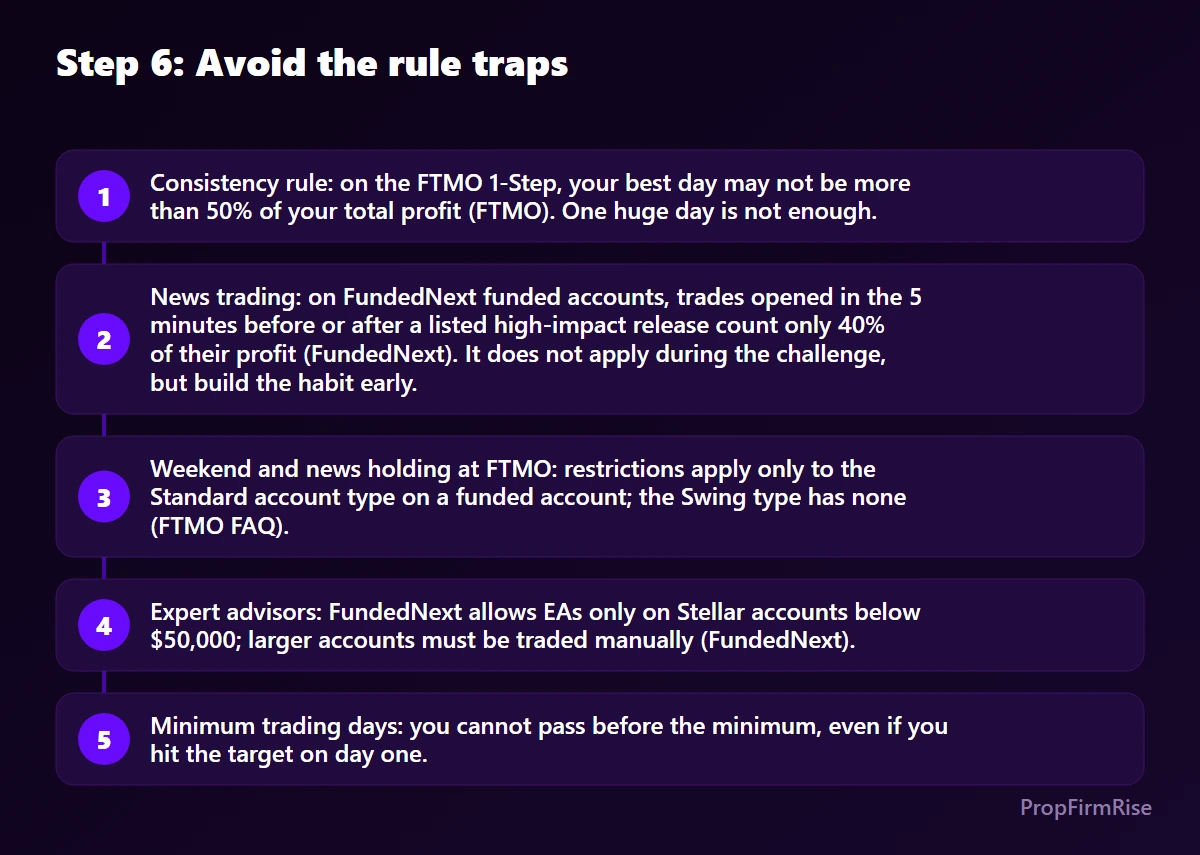
Accounts are often lost on rules that have nothing to do with the profit target:
- Consistency rule: on the FTMO 1-Step, your best day may not be more than 50% of your total profit (FTMO). One huge day is not enough.
- News trading: on FundedNext funded accounts, trades opened in the 5 minutes before or after a listed high-impact release count only 40% of their profit (FundedNext). It does not apply during the challenge, but build the habit early.
- Weekend and news holding at FTMO: restrictions apply only to the Standard account type on a funded account; the Swing type has none (FTMO FAQ).
- Expert advisors: FundedNext allows EAs only on Stellar accounts below $50,000; larger accounts must be traded manually (FundedNext).
- Minimum trading days: you cannot pass before the minimum, even if you hit the target on day one.
Step 7: Pick the model and size that fit how you trade
Choose the account to match your strategy, not the biggest number on the page:
- Deeper losing streaks: a 2-step gives you a 10% maximum loss and a 5% daily limit.
- Fast, low-drawdown style: a 1-step skips the second phase but tightens the daily limit to 3%.
- First challenge: start small. Both firms refund the 2-step fee with your first reward, so a smaller account keeps the cost of a failed attempt low.
Our FTMO vs FundedNext comparison lines up both firms' rules and prices model by model, and the discount codes page lists current codes.
Your pre-challenge checklist
- Write down the target, daily limit, maximum loss and minimum days for your exact account.
- Choose a fixed risk per trade between 0.25% and 0.5% for a 2-step.
- Set a personal daily stop at about half the firm's daily limit.
- Decide the maximum number of losing trades per day before you stop.
- Check the consistency, news, weekend and EA rules that apply to you.
- Mark high-impact news on your calendar for the whole challenge.
- Review every trade at the end of the day against this plan.
Frequently asked questions
How long does it take to pass a prop firm challenge?
There is no fixed answer, because FTMO and FundedNext set no time limit. The only floor is the minimum number of trading days: 4 per phase at FTMO and 5 per phase at FundedNext (FTMO, FundedNext).
What is the best risk per trade for a challenge?
For a 2-step with a 10% maximum loss, 0.25–0.5% per trade leaves room for 20–40 losing trades in a row. That is our own calculation (10% divided by the risk per trade). Higher risk passes faster when it works and fails much faster when it does not.
Is a 1-step or 2-step challenge easier to pass?
A 2-step has wider loss limits; a 1-step has one phase but tighter limits. See what is a prop firm challenge for how the models differ, and pick the one that fits your normal drawdown.
Sources
Rules were checked on 26 November 2026 on the official pages: FTMO Trading Objectives, FTMO FAQ, FundedNext Stellar 2-Step, FundedNext Stellar 1-Step and FundedNext news rule. Risk tables are PropFirmRise calculations from those limits. Read our affiliate disclosure.