Daily loss vs max loss: how prop firm drawdown limits work
The daily loss limit caps one day's losses; the maximum loss caps the whole account. How both are measured, with worked examples on a $100,000 account.
The daily loss limit caps how much you can lose in a single day; the maximum loss caps how far the whole account can fall. Break either one and the challenge is over, even if you are close to the profit target. On a typical $100,000 2-step account, that means losing no more than $5,000 in a day and never letting equity drop below $90,000. This guide shows how each limit is measured, how the two interact, and how to trade inside them, using the official rules of FTMO and FundedNext checked on 26 November 2026.
The two limits on a $100,000 account
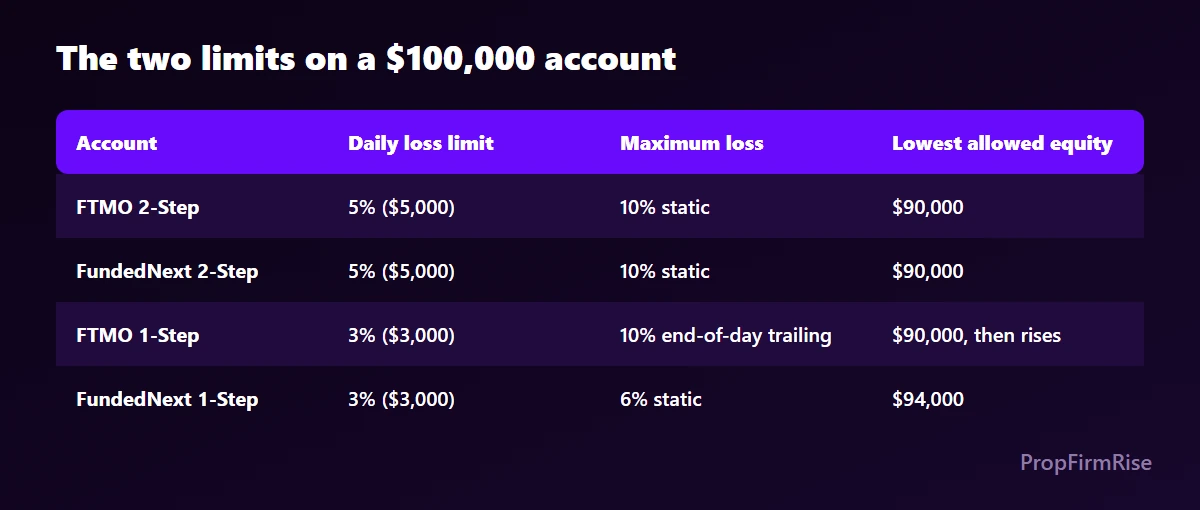
| Account | Daily loss limit | Maximum loss | Lowest allowed equity |
|---|---|---|---|
| FTMO 2-Step | 5% ($5,000) | 10% static | $90,000 |
| FundedNext 2-Step | 5% ($5,000) | 10% static | $90,000 |
| FTMO 1-Step | 3% ($3,000) | 10% end-of-day trailing | $90,000, then rises |
| FundedNext 1-Step | 3% ($3,000) | 6% static | $94,000 |
The figures come from each firm's rules pages (FTMO, FundedNext 2-Step, FundedNext 1-Step). Both percentages are taken from your starting balance, not from your current balance.
The daily loss limit
The daily loss limit is the most you may lose in one trading day. The detail that catches traders out is where "the day" starts.
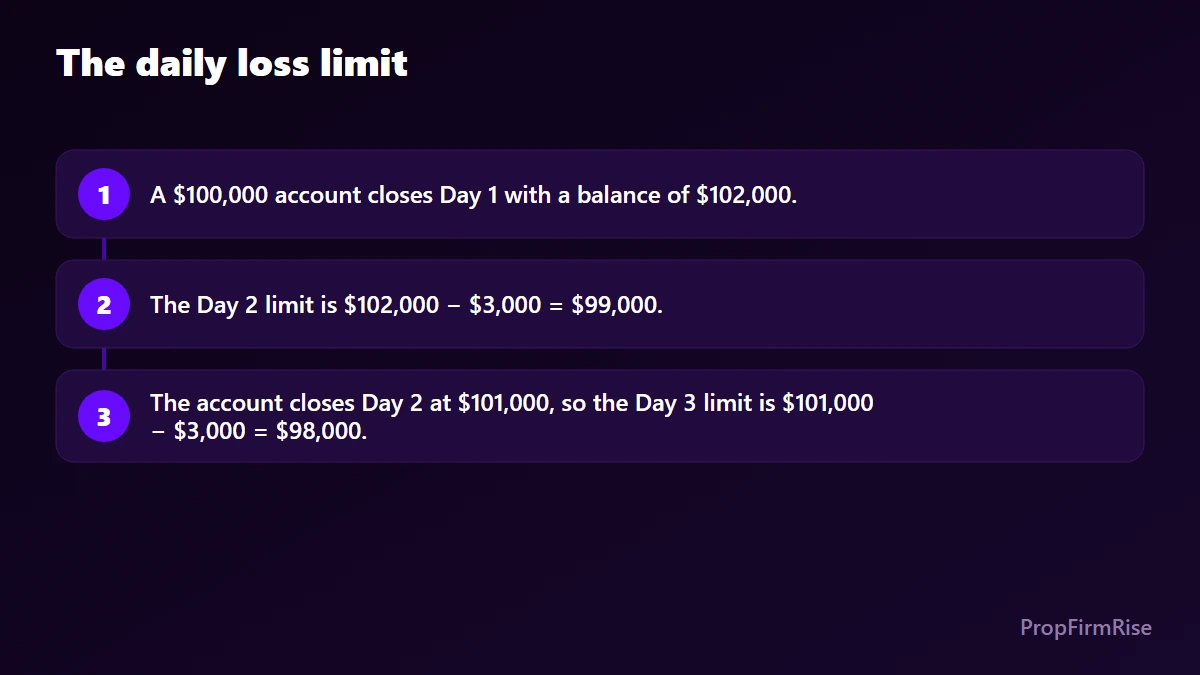
At FTMO, the limit is recalculated every day at 00:00 CE(S)T: it is your balance at that moment minus the daily amount, which is a fixed percentage of the starting balance (FTMO). FTMO's own example for a 1-Step account with a 3% limit:
- A $100,000 account closes Day 1 with a balance of $102,000.
- The Day 2 limit is $102,000 − $3,000 = $99,000.
- The account closes Day 2 at $101,000, so the Day 3 limit is $101,000 − $3,000 = $98,000.
On a 2-Step with a 5% limit, the same Day 1 close of $102,000 would set the Day 2 limit at $97,000.
FundedNext states its Stellar daily limit as a percentage of the initial balance per day – 5% on the 2-Step and 3% on the 1-Step (FundedNext). Check its Help Center for exactly when the day resets before you trade around midnight.
Open trades count
The limit applies to your equity, not just closed trades. FTMO defines equity as balance plus open profit or loss, minus swaps and commissions (FTMO). A floating loss can break the daily limit even if you never close the trade, and swaps and commissions count too.
The maximum loss
The maximum loss is the total amount your account may fall over the whole challenge. There are two types:
- Static: the floor is fixed from day one. On a $100,000 FTMO 2-Step it stays at $90,000 however much profit you make (FTMO). FundedNext's Stellar 2-Step floor is also 90% of the starting balance, and the Stellar 1-Step floor is 94% (FundedNext).
- Trailing: the floor rises with your best balance and never falls. On the FTMO 1-Step it trails the highest end-of-day balance by a fixed 10% of the starting balance: close a day at $105,000 and the floor moves from $90,000 to $95,000 (FTMO).
Our guide to trailing drawdown covers the trailing type in detail.
How the two limits interact
You have to respect both limits at all times, and the one that is closer is the one that matters. Two examples on a $100,000 2-step account with a 5% daily limit and a $90,000 floor:
- Daily limit hits first. You start the day at $100,000 and lose $5,000 by lunch. You are still $5,000 above the $90,000 floor, but the daily limit is broken.
- Maximum loss hits first. After a bad week you start the day at $93,000. The daily limit would allow a loss down to $88,000, but the floor is $90,000, so you only have $3,000 of room that day.
In practice, your room for any day is the smaller of the two: what the daily limit allows, and the distance to the maximum-loss floor.
How to stay inside both limits
- Fix your risk per trade. At 0.5% per trade you can take 10 losing trades in a row before a 5% daily limit and 20 before a 10% maximum loss. At 2%, it takes only 3 losing trades to break the daily limit.
- Set a personal daily stop at about half the firm's limit, for example 2–2.5% on a 5% rule. That leaves room for slippage, gaps and the trade you are already in.
- Check your room before the first trade of the day. If you are near the maximum-loss floor, your real daily limit is smaller than the firm's.
- Close or reduce positions before you stop, so a floating loss cannot keep growing after you walk away.
These risk figures are our own calculation (limit divided by risk per trade). The full method is in our guide on how to pass a prop firm challenge.
Frequently asked questions
Does the daily loss limit reset every day?
Yes. At FTMO it is recalculated at 00:00 CE(S)T from your balance at that time (FTMO). A losing day does not carry over to the next day's daily limit. It does lower your room to the maximum-loss floor.
Do open trades count toward the limits?
Yes. Both limits are checked against equity, which includes floating profit or loss on open positions (FTMO).
Which limit is stricter?
It depends on where you are. Early in a challenge the daily limit is usually closer; after a run of losing days the maximum loss can become the tighter one, as the $93,000 example shows.
Sources
Checked on 26 November 2026: FTMO Trading Objectives, FundedNext Stellar 2-Step and FundedNext Stellar 1-Step. Risk figures are PropFirmRise calculations from those limits. Compare limits across firms with our comparison tool and read our affiliate disclosure.