Trailing drawdown explained: end-of-day vs intraday
A trailing drawdown moves up as your account grows and never moves down. How end-of-day and intraday trailing work, with worked examples on FTMO accounts.
A trailing drawdown is a maximum-loss floor that rises as your account makes new highs and never moves back down. With a static limit, the lowest your account may go is fixed from day one. With a trailing limit, every new high lifts the floor, so profit you give back reduces your room. What matters most is *when* the floor moves: once a day on the closing balance (end-of-day trailing), or during the day (intraday trailing). This guide explains both with worked examples from FTMO's official rules, checked on 26 November 2026.
Static vs trailing in one example
Take a $100,000 account with a 10% maximum loss ($10,000).
- Static: the floor is $90,000 on day one and stays there, even if the account grows to $108,000.
- Trailing: if the account grows to $108,000, the floor rises to $98,000. A fall back to $98,000 ends the account, even though it is still in profit.
That is why trailing limits feel strict: the room you have is measured from your best balance, not from where you started.
End-of-day (EOD) trailing
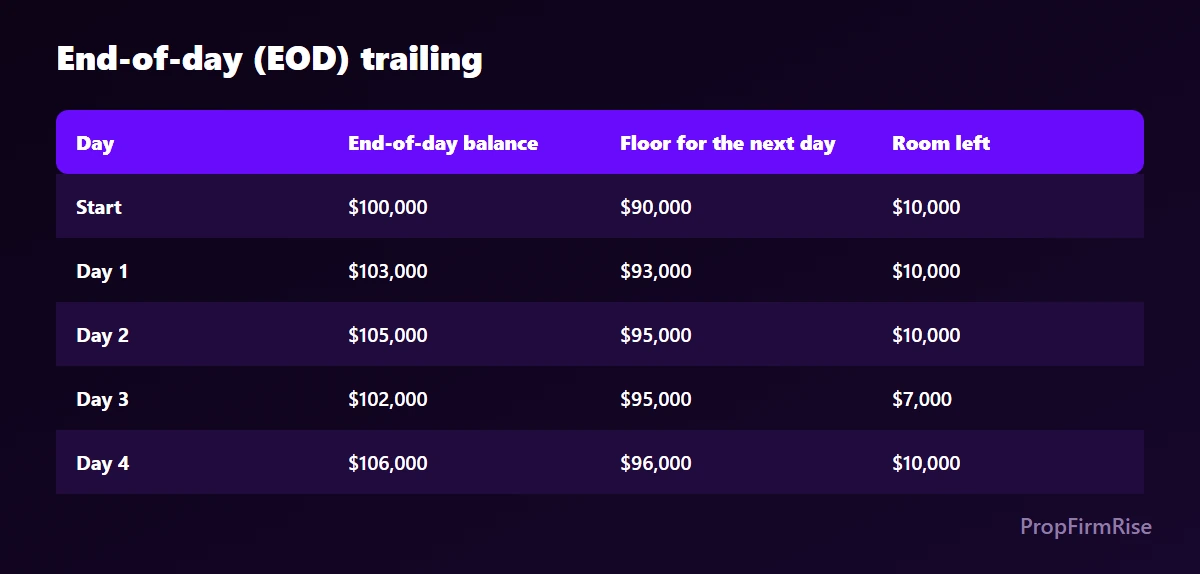
With end-of-day trailing, the floor is recalculated once a day from your closing balance. Swings during the session do not move it.
The FTMO 1-Step works this way. Its maximum loss is a fixed 10% of the starting balance below the highest balance recorded at 00:00 CE(S)T, and the limit can only increase, never decrease (FTMO). On a $100,000 account:
| Day | End-of-day balance | Floor for the next day | Room left |
|---|---|---|---|
| Start | $100,000 | $90,000 | $10,000 |
| Day 1 | $103,000 | $93,000 | $10,000 |
| Day 2 | $105,000 | $95,000 | $10,000 |
| Day 3 | $102,000 | $95,000 | $7,000 |
| Day 4 | $106,000 | $96,000 | $10,000 |
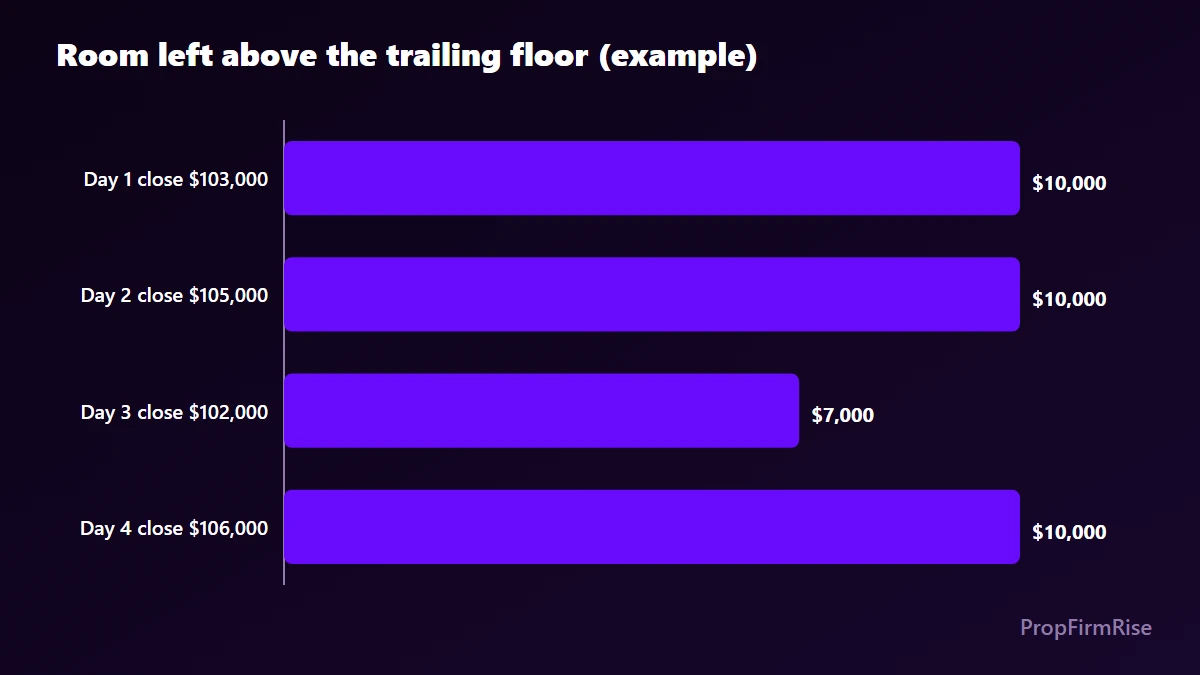
This worked example is our own calculation using FTMO's rule. Look at Day 3: the account is still $2,000 in profit, but the room left has shrunk to $7,000 because the floor stayed at the Day 2 high.
One more FTMO detail: when you withdraw a reward and receive a new FTMO Account, the 1-Step limit fully resets to 90% of the starting balance (FTMO).
Intraday trailing
With intraday trailing, the floor can move during the day. There are two kinds, and the difference is large.
Balance-based intraday trailing
The floor moves the moment a trade closes at a new balance high. Floating profit on open trades does not move it. The FTMO Instant Account uses this type: its floor sits a fixed 10% of the starting balance below your highest balance and updates in real time (FTMO). On a $100,000 Instant Account, closing a trade that takes the balance to $101,500 lifts the floor from $90,000 to $91,500 straight away.
Unlike the 1-Step, the Instant Account's limit does not reset when you withdraw a reward. FTMO warns that once your balance is above 110% of the starting balance, a reward withdrawal would itself breach the limit (FTMO). Plan your withdrawals with that in mind.
Equity-based intraday trailing
The strictest type. The floor follows your highest equity, including unrealised profit on open trades. If a trade runs $800 into profit and then comes back to break-even, the floor has already moved up $800, even though the trade closed flat. Check your firm's rules page: if it says the limit follows equity in real time, this is the type you have.
Which type is easier to trade?
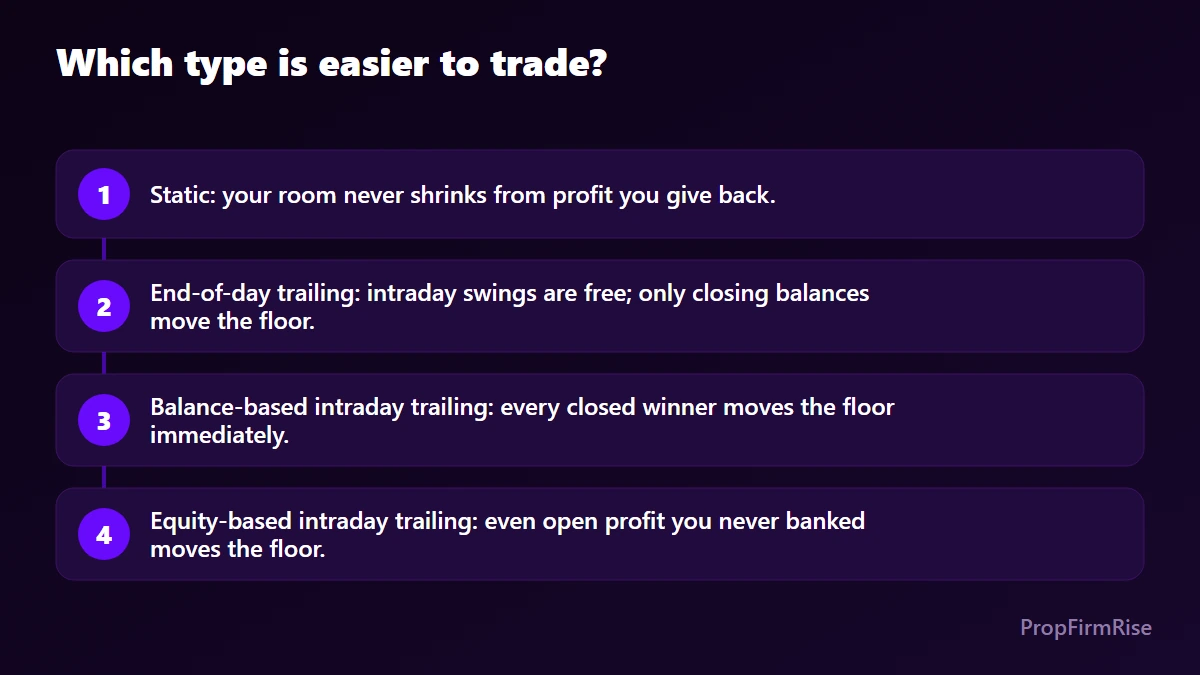
From most to least forgiving:
- Static: your room never shrinks from profit you give back.
- End-of-day trailing: intraday swings are free; only closing balances move the floor.
- Balance-based intraday trailing: every closed winner moves the floor immediately.
- Equity-based intraday trailing: even open profit you never banked moves the floor.
How to trade a trailing drawdown
- Keep risk per trade fixed after a winning streak. Under a trailing limit, profit does not buy extra room, so bigger size after a good week only shortens your cushion.
- On end-of-day accounts, watch your close. A strong day that closes near its high lifts the floor the most. Taking profit before the close of a volatile day is a valid choice.
- On equity-based accounts, protect open winners early. Partial profits or moving the stop to break-even stop a round-trip from eating your room.
- Know your room every morning. Room = current balance minus the floor. If it is below your normal risk for the day, trade smaller or not at all.
For position sizing in numbers, see how to pass a prop firm challenge. For the difference between the daily limit and the maximum loss, see daily loss vs max loss.
Frequently asked questions
Does a trailing drawdown ever stop trailing?
It depends on the firm. At FTMO the 1-Step and Instant limits keep rising with new highs and never decrease (FTMO); only the 1-Step resets after a reward withdrawal and new account. Other firms may lock the floor at a certain level, so read your firm's rules.
Is end-of-day trailing better than intraday?
For most traders, yes: intraday swings do not move an end-of-day floor, while an intraday floor reacts to every new high. Scalpers who bank profits quickly are the least affected by intraday trailing.
Do FTMO 2-Step accounts use trailing drawdown?
No. The FTMO 2-Step uses a static 10% maximum loss (FTMO). Compare the models in what is a prop firm challenge.
Sources
Rules from the FTMO Trading Objectives, checked on 26 November 2026. The worked examples are PropFirmRise calculations from those rules. See which firms use each model on our prop firms page and read our affiliate disclosure.