What is a prop firm challenge? 1-step vs 2-step vs instant funding
A prop firm challenge is a paid evaluation on a simulated account. How 2-step, 1-step and instant funding work, what they cost and how to choose.
A prop firm challenge is a paid trading test on a simulated account. You pay a one-time fee, trade under fixed rules – a profit target, a daily loss limit and a maximum loss – and if you reach the target without breaking a rule, the firm gives you a funded account and shares the profit you make. There are three main models: the 2-step challenge, the 1-step challenge and instant funding. This guide explains how each works, using the official rules of FTMO and FundedNext, checked on 26 November 2026.
How a challenge works, step by step
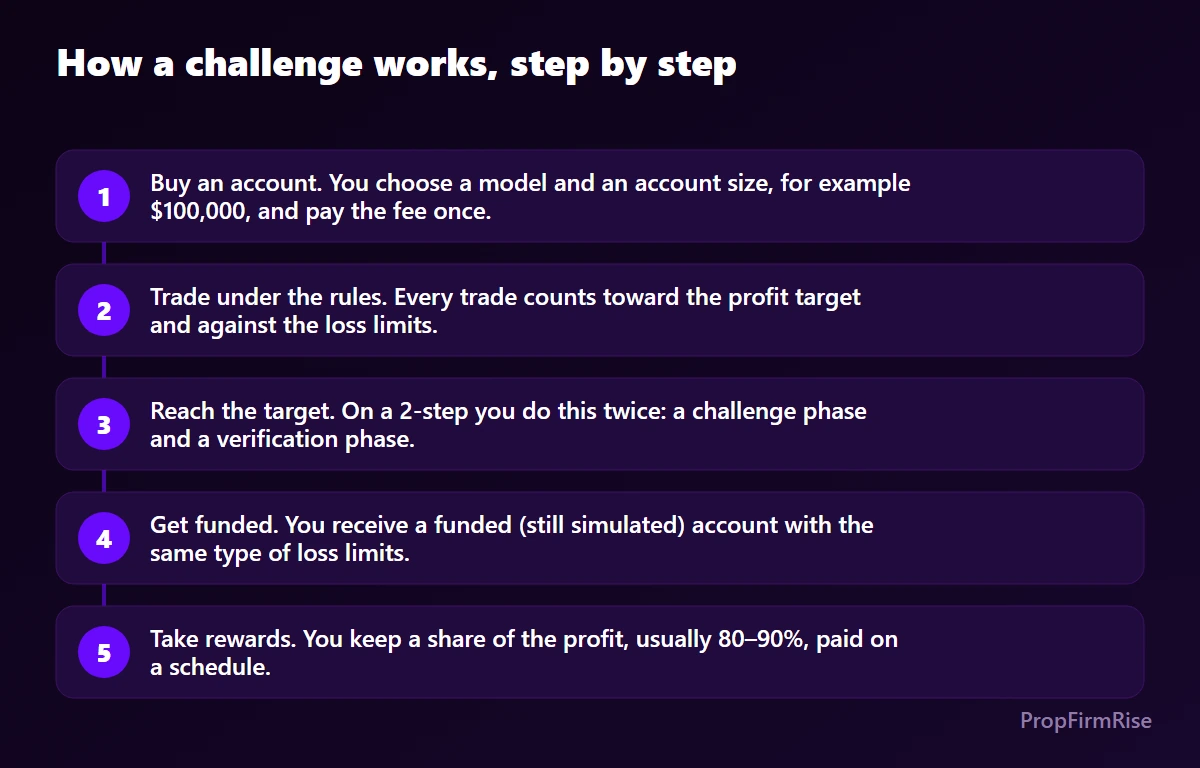
- Buy an account. You choose a model and an account size, for example $100,000, and pay the fee once.
- Trade under the rules. Every trade counts toward the profit target and against the loss limits.
- Reach the target. On a 2-step you do this twice: a challenge phase and a verification phase.
- Get funded. You receive a funded (still simulated) account with the same type of loss limits.
- Take rewards. You keep a share of the profit, usually 80–90%, paid on a schedule.
The accounts are simulated: FTMO calls the starting balance the "Initial Simulated Capital" (FTMO). Your money at risk is the fee you paid, not a trading balance.
What you pay, and when you get it back
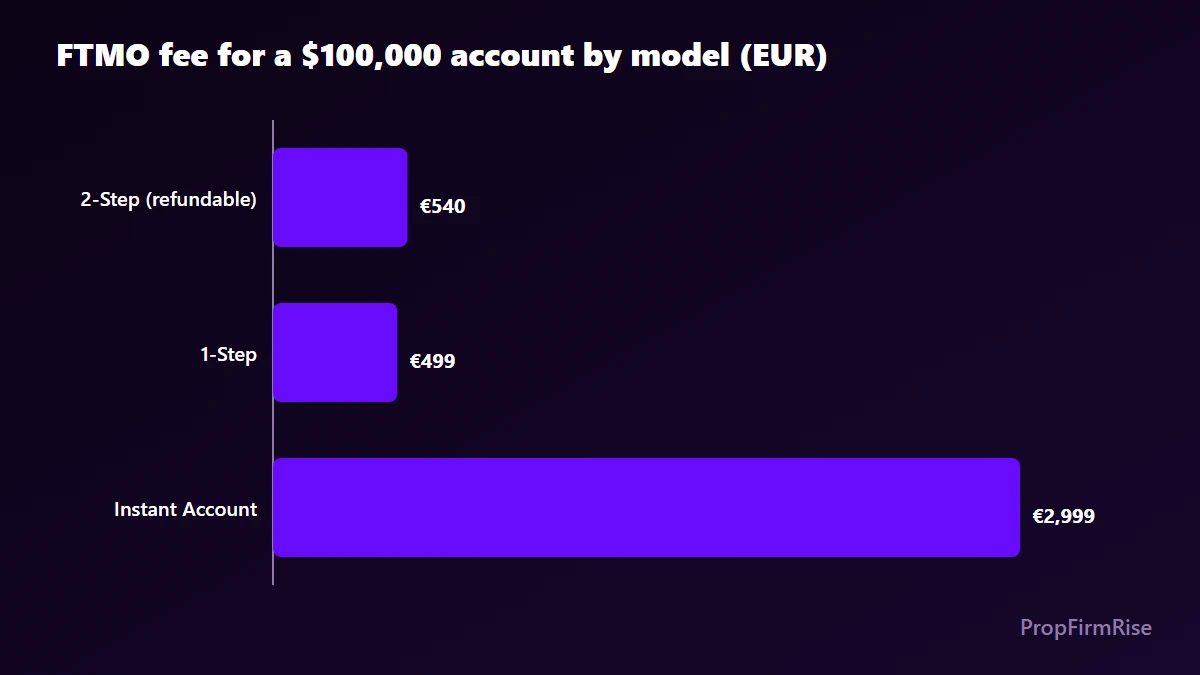
The fee depends on the model and size. At FTMO a $100,000 account costs €540 for the 2-Step, €499 for the 1-Step and €2,999 for the Instant Account at regular prices (FTMO). FundedNext charges $549.99 for a $100,000 Stellar 2-Step and $569.99 for the Stellar 1-Step (FundedNext).
Refund rules differ by model:
- FTMO: the 2-Step fee is refunded with your first reward; the 1-Step and Instant fees are not refundable (FTMO FAQ).
- FundedNext: both Stellar fees are refunded – the 2-Step with your first reward, the 1-Step with your 3rd reward for accounts bought from 12 January 2026 (FundedNext).
The three models at a glance
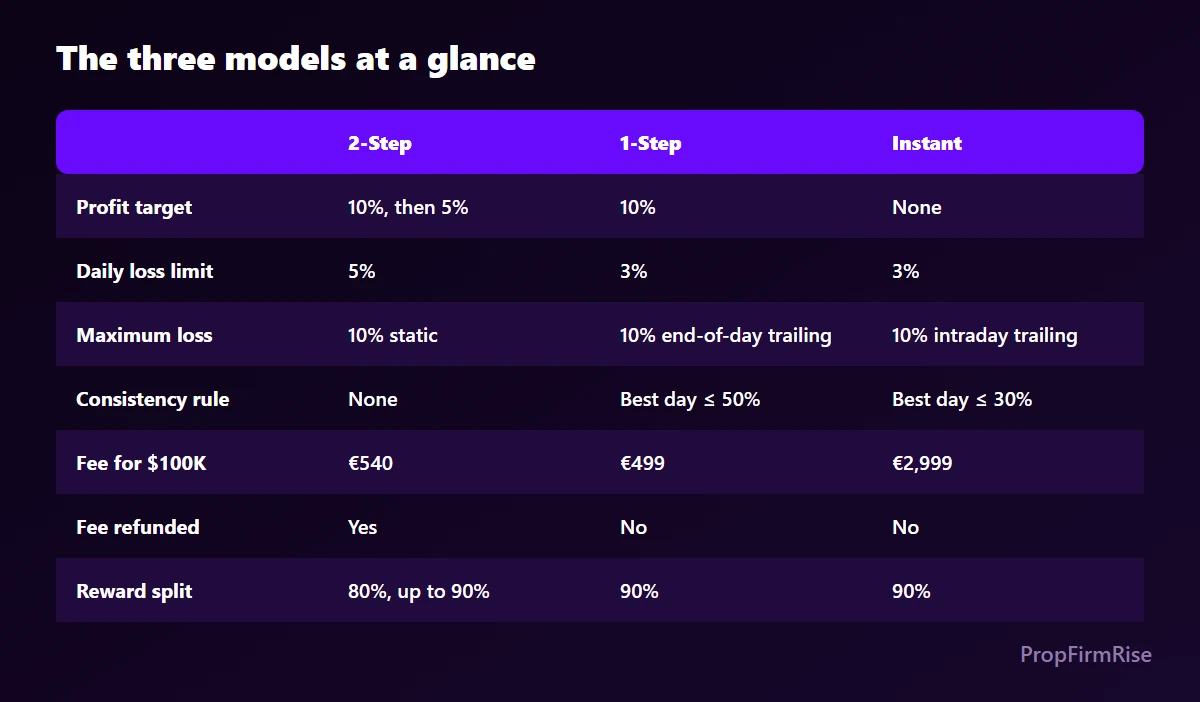
FTMO offers all three models, so it makes a clean comparison. Figures for a $100,000 account (FTMO Trading Objectives, pricing):
| 2-Step | 1-Step | Instant | |
|---|---|---|---|
| Profit target | 10%, then 5% | 10% | None |
| Daily loss limit | 5% | 3% | 3% |
| Maximum loss | 10% static | 10% end-of-day trailing | 10% intraday trailing |
| Consistency rule | None | Best day ≤ 50% | Best day ≤ 30% |
| Fee for $100K | €540 | €499 | €2,999 |
| Fee refunded | Yes | No | No |
| Reward split | 80%, up to 90% | 90% | 90% |
The 2-step challenge
The classic model. You pass a challenge phase, then a verification phase with a smaller target, under the same loss limits:
- FTMO 2-Step: 10% then 5%, with a 5% daily limit, a 10% static maximum loss and at least 4 trading days per phase (FTMO).
- FundedNext Stellar 2-Step: 8% then 5%, with a 5% daily limit, a 10% maximum loss and at least 5 trading days per phase (FundedNext).
Two phases take longer, but the loss limits are the widest of the three models and both firms refund the fee. That makes the 2-step the usual starting point for a first challenge.
The 1-step challenge
One phase, one target, and tighter loss rules to make up for the shorter path:
- FTMO 1-Step: 10% target, 3% daily limit and a 10% maximum loss that trails your highest end-of-day balance. Your best day may not exceed 50% of your total profit (FTMO).
- FundedNext Stellar 1-Step: 10% target, 3% daily limit and a 6% static maximum loss, with at least 2 trading days (FundedNext).
A 1-step suits traders with a proven, low-drawdown strategy. If your strategy has deeper losing streaks, the extra room of a 2-step is usually worth the extra phase. Our guide to trailing drawdown explains the FTMO-style trailing limit.
Instant funding
No evaluation: you trade a funded account from day one. The FTMO Instant Account has no profit target, a 3% daily limit, a 10% maximum loss that trails intraday, a 30% consistency rule and a 90% reward split (FTMO).
The trade-off is price. A $100,000 Instant Account costs €2,999, more than five times the €540 2-Step fee for the same size, and the fee is not refundable (FTMO). Instant funding makes sense only if starting immediately is worth that premium to you.
What happens after you pass
Once funded, you keep trading under similar loss limits and request rewards:
- FTMO: 80% on 2-Step accounts, raised to 90% through the Scaling Plan; 90% on the 1-Step. The first reward can be requested from the 14th day after your first trade (FTMO FAQ).
- FundedNext: 80%, rising to 90% after Scale-Up. Stellar 2-Step rewards start after 21 days and then come every 14 days; Stellar 1-Step rewards come every 5 business days (FundedNext).
How to choose
- New to prop trading: a small 2-step account. The widest limits and a refundable fee keep the cost of learning low.
- Consistent, low-drawdown trader: a 1-step saves time, if you accept tighter limits.
- Need a funded account today: instant funding, if the much higher fee makes sense for you.
Before you buy, read our plan to pass a prop firm challenge, learn the difference between daily loss and maximum loss, and compare firms in our FTMO vs FundedNext guide. Current codes are on our discount codes page.
Frequently asked questions
Do you trade real money in a prop firm challenge?
No. Challenge and funded accounts are simulated; FTMO describes its account balance as Initial Simulated Capital (FTMO). The money you put in is the fee.
Is there a time limit?
Not at FTMO or FundedNext: neither sets a time limit on its challenges, but both set a minimum number of trading days on the 2-step (FTMO, FundedNext).
Which model is easiest to pass?
The 2-step has the widest loss limits; the 1-step has one phase but tighter limits; instant funding has no target but costs far more. "Easiest" depends on your normal drawdown – see how to pass a prop firm challenge.
Sources
Checked on 26 November 2026: FTMO Trading Objectives, FTMO pricing, FTMO refunds, FTMO rewards, FundedNext Stellar 2-Step, FundedNext Stellar 1-Step and FundedNext reward frequency. Read our affiliate disclosure.