FTMO vs FundedNext (2026): Rules, Prices and Payouts Compared
 FTMO★ 5.0
 FundedNext★ 5.0
FTMO vs FundedNext compared model by model: profit targets, loss limits, fees, refunds, reward split and payout timing, from both firms' official pages.
FTMO vs FundedNext comes down to which model you trade. On the 2-step, FundedNext is easier to pass: its first-phase target is 8% instead of 10%, with the same 5% daily and 10% maximum loss limits. On the 1-step, FTMO gives you more room, with a 10% maximum loss against FundedNext's 6%. The catch is that FTMO's limit trails your best end-of-day balance and its fee is not refunded. Every figure below comes from the two firms' official pages. We checked the FTMO Trading Objectives and the FundedNext Help Center on 26 November 2026.
Rules and prices change often. Check both firms' pages before you buy, and read our affiliate disclosure.
FTMO vs FundedNext at a glance
| FTMO | FundedNext | |
|---|---|---|
| Models compared | FTMO Challenge 2-Step, 1-Step | Stellar 2-Step, Stellar 1-Step |
| Account sizes | $10K to $200K | $6K to $200K |
| Fee currency | EUR | USD |
| Time limit | None | None |
| Reward split | 80% (2-Step), up to 90%; 90% (1-Step) | 80%, 90% after Scale-Up, 95% with an add-on |
| First reward | From day 14 after your first trade | 21 days (2-Step), 5 business days (1-Step) |
| Platforms | MT4, MT5, cTrader, TradingView | MT4, MT5, cTrader, Match-Trader |
Both firms have no time limit on their evaluations, so the differences sit in the targets, the loss limits and what happens to your fee.
2-Step: FTMO Challenge vs Stellar 2-Step
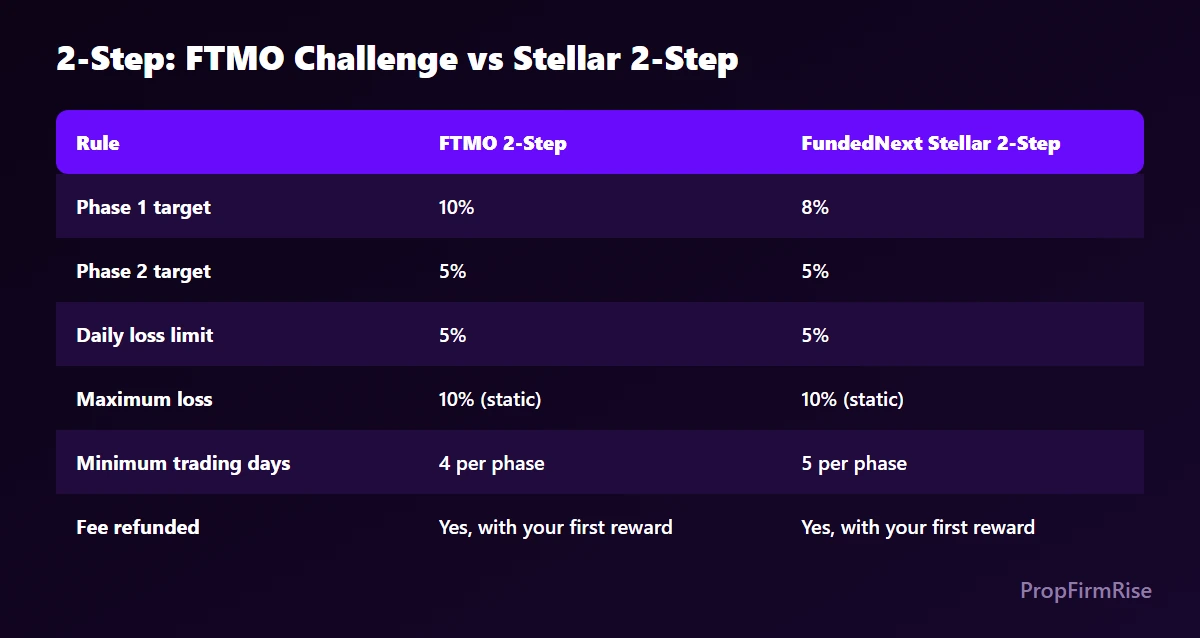
The 2-step is the classic route: pass a first phase, pass a verification phase, then trade a funded account. If the model is new to you, start with our guide what is a prop firm challenge.
| Rule | FTMO 2-Step | FundedNext Stellar 2-Step |
|---|---|---|
| Phase 1 target | 10% | 8% |
| Phase 2 target | 5% | 5% |
| Daily loss limit | 5% | 5% |
| Maximum loss | 10% (static) | 10% (static) |
| Minimum trading days | 4 per phase | 5 per phase |
| Fee refunded | Yes, with your first reward | Yes, with your first reward |
The loss limits are identical: 5% per day and a static 10% overall, measured from your starting balance on both sides (FTMO, FundedNext). The real difference is the first target. Making 8% instead of 10% means one fewer winning week for most traders, while the drawdown room stays the same. FundedNext asks for one more minimum trading day per phase, which rarely matters in practice.
If you are unsure how the two loss limits interact, read daily loss vs max loss before you choose an account size.
1-Step: FTMO 1-Step vs Stellar 1-Step
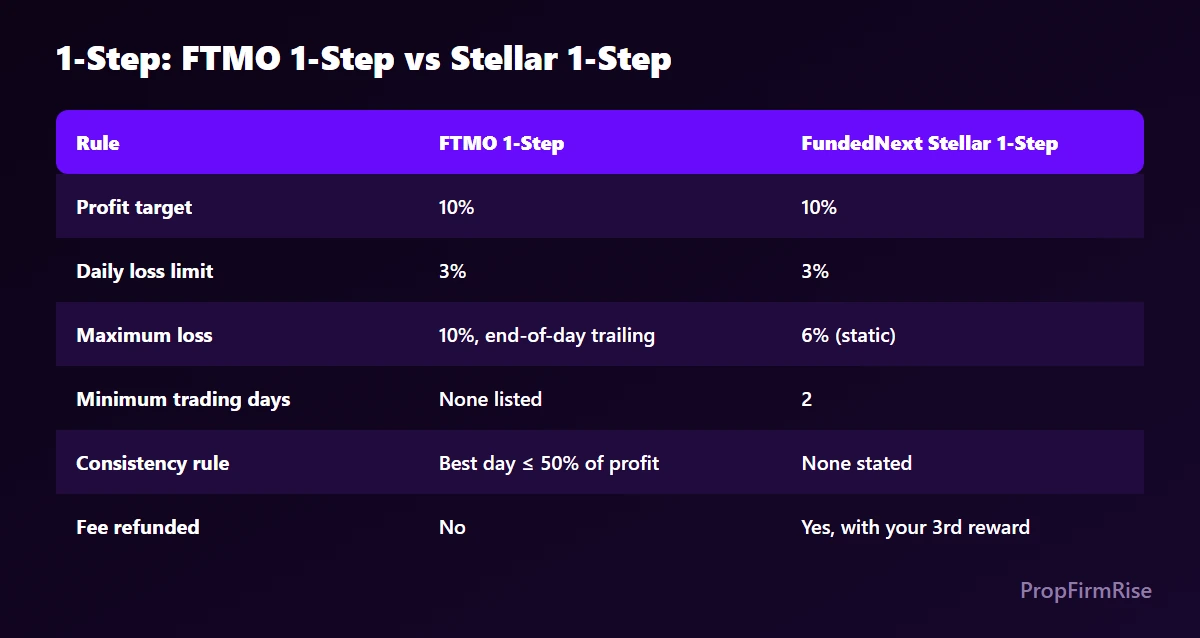
The 1-step models look similar on the surface: one phase and a 10% target at both firms (FTMO, FundedNext). The loss rules are where they split.
| Rule | FTMO 1-Step | FundedNext Stellar 1-Step |
|---|---|---|
| Profit target | 10% | 10% |
| Daily loss limit | 3% | 3% |
| Maximum loss | 10%, end-of-day trailing | 6% (static) |
| Minimum trading days | None listed | 2 |
| Consistency rule | Best day ≤ 50% of profit | None stated |
| Fee refunded | No | Yes, with your 3rd reward |
A static maximum loss is a floor fixed at your starting balance minus the limit; it never moves. An end-of-day trailing maximum loss is a floor that rises with your highest closing balance of the day, but never falls.
FTMO's maximum loss is a fixed 10% of your starting balance, measured from your highest end-of-day balance, and the floor never moves back down (FTMO). On a $100,000 account the floor starts at $90,000, but after you close a day at $105,000 it rises to $95,000. FundedNext's 6% limit never moves: on a $100,000 account your balance or equity must stay above $94,000 for the whole challenge (FundedNext).
Which is easier depends on how you trade. A trader who builds profit early gets locked in by FTMO's trailing floor. A trader who dips before recovering is safer with FTMO's wider 10% than with FundedNext's 6%. Our guide to trailing drawdown shows how end-of-day trailing works step by step.
FTMO also applies a consistency rule to the 1-Step: your best day cannot be more than 50% of your total profit (for orders from 12 October 2026, per the Trading Objectives). One big winning day is not enough on its own.
Our analysis: profit target vs loss room
One way to compare the four models is to divide the profit target by the maximum loss. The result shows how much you must make for every unit of room you are allowed to lose. Lower is easier. This is our own calculation from the official rules (FTMO, FundedNext 2-Step, FundedNext 1-Step).
| Model | Target (first phase) | Maximum loss | Target ÷ loss room |
|---|---|---|---|
| FundedNext Stellar 2-Step | 8% | 10% | 0.8 |
| FTMO 2-Step | 10% | 10% | 1.0 |
| FTMO 1-Step | 10% | 10% (trailing) | 1.0 |
| FundedNext Stellar 1-Step | 10% | 6% | 1.67 |
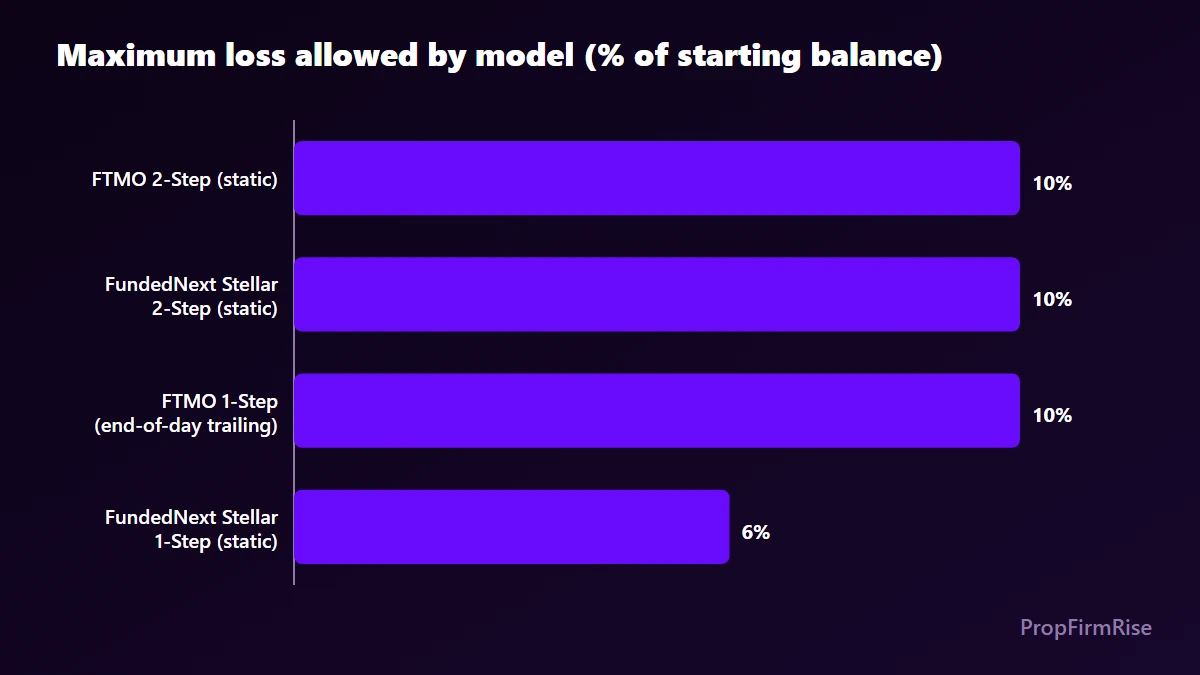
Two things stand out. The FundedNext Stellar 2-Step is the only model where the first target is smaller than the room you have to lose. And the FundedNext Stellar 1-Step asks for 1.67 times its loss room, the hardest ratio of the four. FTMO's 1-Step looks equal to its 2-Step on paper. In practice it is tighter once you are in profit, because the trailing floor follows your gains, and it adds the 50% consistency rule.
Prices: what each challenge costs
FTMO prices its challenges in euros and FundedNext in US dollars, so we do not convert them here. The account sizes also differ slightly. FTMO's regular prices from its pricing table:
| Account | FTMO 2-Step | FTMO 1-Step |
|---|---|---|
| $10K | €89 | €79 |
| $25K | €250 | €199 |
| $50K | €345 | €319 |
| $100K | €540 | €499 |
| $200K | €1,080 | €999 |
FundedNext's prices, as listed (approximately) in its Stellar 2-Step and Stellar 1-Step articles:
| Account | Stellar 2-Step | Stellar 1-Step |
|---|---|---|
| $6K | $59.99 | $65.99 |
| $15K | $119.99 | $129.99 |
| $25K | $199.99 | $219.99 |
| $50K | $299.99 | $329.99 |
| $100K | $549.99 | $569.99 |
| $200K | $999.99 | $1,099.99 |
At the time of checking, FTMO was running a Black Friday sale showing prices 20–30% lower on its website. That is a limited-time offer, so the table shows the regular prices. For current codes on FundedNext and other firms, see our discount codes page.
Refunds: what happens to your fee
Both firms refund the 2-step fee with your first reward, so a funded trader effectively gets the challenge back for free (FTMO FAQ, FundedNext).
The 1-step is different. FTMO states that the 1-Step fee is not refundable. FundedNext refunds the Stellar 1-Step fee, but for accounts bought on or after 12 January 2026 the refund comes with your 3rd reward, not the first (FundedNext).
Reward split and payout timing
FTMO. On the 2-Step you keep 80% of simulated profit, raised to 90% once you meet the Scaling Plan or Premium Programme conditions. The 1-Step pays 90% from the start. You can request your first reward from the 14th day after your first trade, and FTMO reviews requests in 1–2 business days (FTMO FAQ). The Scaling Plan adds 25% to your account every 4 months, up to $2,000,000, if you make at least 10% net profit and take 2 rewards in that period.
FundedNext. Both Stellar models start at 80% and move to 90% after Scale-Up, and a paid Lifetime Reward add-on sets the split at 95%. Stellar 2-Step rewards come 21 days after you start, then every 14 days; Stellar 1-Step rewards come every 5 business days (FundedNext). The 2-Step also offers a 3-day option at a 60% split and an on-demand option at 90%.
In short: FundedNext's 1-step pays most often, while FTMO's 1-step keeps the highest split from day one.
Platforms, news and trading style
FTMO supports MT4, MT5, cTrader and TradingView (FTMO). FundedNext supports MT4, MT5, cTrader and Match-Trader, with TradingView for analysis only. Its $100,000 and $200,000 accounts cannot be bought on cTrader or Match-Trader (FundedNext).
News trading works differently once you are funded:
- FTMO: news and weekend restrictions apply only to the Standard account type on a funded account. The Swing account type has none, but Swing is not offered on the 1-Step.
- FundedNext: on a funded account, trades opened in the 5 minutes before or after a listed high-impact release count only 40% of their profit (FundedNext). The rule does not apply during the challenge.
FTMO or FundedNext: which should you choose?
- You want the easiest 2-step: FundedNext Stellar 2-Step. Same loss limits as FTMO, lower first-phase target.
- You trade a 1-step with deeper dips before winners: FTMO 1-Step, for the wider 10% limit, if you accept a non-refundable fee and the 50% consistency rule.
- You want frequent payouts: FundedNext Stellar 1-Step, with rewards every 5 business days.
- You hold trades over news or weekends on a funded account: FTMO 2-Step with the Swing account type.
- You want the biggest growth path: FTMO's Scaling Plan has a published path to $2,000,000.
Whichever you pick, start with a size you can afford to lose. Most traders do not pass on the first attempt. Our full FTMO review and FundedNext review cover each firm in more depth, and the comparison tool lets you line them up against other firms.
Sources
All figures were checked on 26 November 2026 on the firms' official pages: FTMO Trading Objectives, FTMO pricing, FTMO refunds, FTMO rewards, FTMO Scaling Plan, FundedNext Stellar 2-Step, FundedNext Stellar 1-Step, FundedNext reward frequency and FundedNext news rule.